Publications
Maurice Herlihy, Aditya Mohan, "Peer-to-Peer Multiplayer Gaming using Arrow Multicast: Peer-to-Peer Quake ", The 23rd International Conference on Distributed Computing Systems (ICDCS-2003) Providence, Rhode Island USA, May 19-22, 2003.
[ www, www_poster]
Box.net folder: Summary Slides Thesis report
Graduate School Thesis @ Brown University: Peer-to-peer Multicast for real-time information
A major challenge in the current distributed network environment is to make multicast scalable and fault-tolerance. When working in a peer-to-peer domain, there are numerous applications that require ordering of the multicast packets. Moreover, latency is a concern, especially for interactive applications such as Multiplayer Gaming. We evaluated the effectiveness of a proposed ordered multicast algorithm called Arrow Multicast as a possible solution. The multicast was aimed to be asynchronous, ordered but best effort, where packets can be dropped if the required quality of service (QoS) requirement was not met. QoS in was quantified by the freshness of the packets received and the amount of packets dropped/delivered unordered. The outcome of the thesis was a Multiplayer Peer-to-Peer Quake prototype, which was used as a test bed for our proposed peer-to-peer multicast. The research findings were published as a poster titled "Peer-to-Peer Multiplayer Gaming using Arrow Multicast: Peer-to-Peer Quake ", in The 23rd International Conference on Distributed Computing Systems (ICDCS-2003) Providence, Rhode Island USA, May 19-22, 2003
Characteristics of our approach
- No centralized server Each peer has the full game engine
- Asynchronous – lock-steps not required
- Ordering of Game frames to prevent divergence
- Best effort delivery of frames
We used Arrow Protocol used in directory services
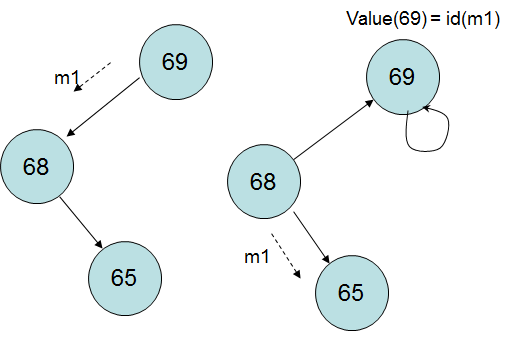
- Message only knows it predecessor
- Path Reversal
- Light Weight
- Minimal state information
- FIND/FLOOD message
- FIND hunts down the predecessor
- FLOOD for unordered multicast
- Message finds its predecessor
- Unordered multicast of message with predecessor info
- Receivers Order with help of predecessor info
Introduction
There
are numerous constraints that one can put on a multicast environment.
Applications may need the multicast to be atomic, where we either deliver a
packet to all or we don't deliver to anyone. It may need to be reliable and
guarantee delivery of packets while other application may just need it to be
"best effort". Timely delivery of the packets is another constraint.
It may need to be ordered, where each packet should arrive at the destination
in the same order that they were generated to maintain consistency among the
different receivers. Some may need total
ordering [5, 26] where packets from all the
sources arrive independently without any form of coordination between each
other. These should be ordered based on the time they were sent; while the
other may require partial ordering
[5, 26] - ordering for packets from a single source. These requirements of
ordering, reliability, timely delivery, and atomicity can be met in synchronous
fashion, where we proceed in lock steps. This solves most of the problem but is
not suitable in an environment like the Internet where the delays can be
variable and nodes have varying processing power. Another approach that has a
wide acceptance among the multicast arena is that Virtual Synchrony, where we
preserve the illusion that events occur instantaneously, but enforces weaker
delivery ordering [3]. The requirement in this case is that of group membership
- every node knows the exact group membership. Any approach that requires the
maintenance of groups is bound to suffer from scalability problem. Hence if
scalability is a requirement, node anonymity is a must. We are interested in an
asynchronous best-effort totally ordered
multicast while maintaining the node anonymity as oppose to group membership.
We also have the constraint that we need to do the multicast in a truly
decentralized peer-to-peer fashion. Through out the paper, we will use the
convention that ordering refers to total ordering.
Total
Ordering has been considered to be expensive. There has been a wide spread
belief that total ordering using a asynchronous protocol with node anonymity
(as opposed to group membership) is not a realizable task. This comes directly
from the believers of the Virtual Synchrony [1].
There
are numerous applications where a best-effort ordered multicast can be useful.
We describe few of them here.
Peer-to-Peer
multimedia video/audio streaming is a good candidate for best-effort ordered
multicast. A network of machines on the Internet, each peer sending live
video/audio stream from his/her web cam to everyone else. A certain packet loss
rate is tolerable, but ordering from a single source needs to be maintained
(partial ordering). Total ordering is required to make sure that, events
(video/audio events) happening among the peers are perceived correctly.
Active
Sensor Networks, where each sensor is capable of receiving, transmitting and
processing information. Consider the data centers of Google Inc with 10,000
Pentium II/III servers running simultaneously at the same time with a density
of 80 servers in a space 7 feet by 2 feet by 2.5 feet. The problem is to
maintaining the data center’s temperature to constant, while not keeping the
air-conditioning on all the time. Moreover a processor may need to shut down
and go to sleep mode if the air-conditioner is working at the maximum limit and
the room temperature is still not optimal. Each processor is connected to an
active thermal sensor, which can wirelessly communicate, with every other
thermal senor embedded in the each of the 10,000 machines. Since the
temperature of the machines keep on changing based on the load on the
processors, the room temperature changes accordingly. Periodically every thermal sensor gets
temperature reading of its local processor and multicast it to every other
processor. Each thermal sensor can itself send commands to other sensors based
on its present state. When a thermal sensor, based on the temperature reading
from other sensors finds that its local processor needs to go to sleep, it
sends a message to others telling them about the local processor ‘s future
state. This is required since other local sensor may be converging to the same
conclusion too. The same is done by the others. Some messages can be lost due
to improper wireless link or due to the microcontrollers in the sensors not
being able to process the information fast enough. But the messages need to be
delivered in order.
The
application that we are using to implement our protocol is Multiplayer Gaming.
We use the Multiplayer version of Quake.
The motive is to remove the central server that is a bottleneck and
makes the system restricted to few players at a time in a game. Intent is to makes
sure that in the Peer-to-Peer Quake, we are able to multicast the movement
packets from each peer to every other peer and keep the state of the global
environment same at each peer. We use Arrow Multicast for ordering packets in
the network.
Our research contribution is to build and analyze an asynchronous multicast infrastructure based on Arrow Multicast protocol and evaluate its performance as an alternative to Virtual Synchrony. Since we are using a user driven application for our implementation (Multiplayer Quake), it is fairly easy to determine if our multicast infrastructure works or not.
System Model
Before we begin to describe our system, there are few assumptions that we make. We assume that we have fixed network of nodes. Ideally these should form a Spanning Tree. This is required to make sure that the message traversal for various Arrow Messages (described later in the paper) is optimal and we don’t go into loops. [2] has proposed methods to make and maintain Spanning Trees and is not the focus of our research.
We don’t consider fault tolerance for now. I.e. a node in the network cannot fail or join abruptly. This requirement implies that we start the multicast only after the Arrow Network is ready with all the TCP connections between different peers in place.
Our system can be considered as building an ordering layer on top of the existing multicast infrastructure. Since we are interested in a best effort approach, we don’t care about the reliability of the message delivery. For the underlying multicast layer, we use the already existing spanning tree. When a node needs to do an unordered multicast (Flooding), it starts delivering the packets to its connected children in the tree. This is done for all nodes except for the one where the packet initially came from. This is done by all the nodes till the whole tree is covered. This could be replaced by other multicast options like IP Multicast.
System Architecture
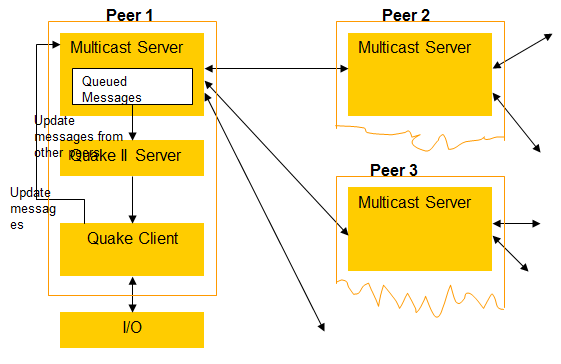
The basic idea is to have a Quake Server (Local Server) running in tandem with a local client in each machine. The Local Server and the Local Client communicates via the Multicast Server in most cases. Multicast Servers of different peers form the Arrow network.
A. Peer-to-Peer Quake
Peer-to-Peer Quake uses a decentralized architecture in which there is no central server, but instead each client itself has the game engine. Each player in our Peer-to-Peer Quake has a logical server running inside her machine. To make sure that the game is playable and the user does not perceive too much delay because of some game frames, the delivery is best effort – the servers may discard some of the frames that are not able to come on time or may deliver the frames unordered. We choose to discard the unordered frames instead of delivering them. This happens whenever the Receive Queue is not able to take more packets. This decision was based on the fact that for applications like Multiplayer Gaming and Multimedia streaming, a packet loss is tolerable since this may only result in a short jitter. On the other hand, an unordered packet will result in a totally unexpected experience. Imagine a situation where we are hit by a missile, without our opponent actually firing it.
The Game Engine is modified to form a logical three-tier architecture consisting of the Multicast server, Quake Server and the Quake Client. The local client generates the movement messages using the keyboard input from the user.
Performance Metrics
A. Order Error
If we never delete any packet from
the Queue structure or we don’t deliver any packet/packet sequence that has a
missing predecessor, then we are bound to have a 100 percent guarantee for
packet ordering since we are not loosing any packet anywhere and we are not
delivering unordered. But this may not
always be in a condition to deliver all packets ordered. Although, we are
assuming a reliable transport, packets may get delayed in the network due to
varying network latencies and congestion. This will result in the packets
coming out of order. We may not want to wait for a full ordering before we
deliver the packets because of the real time nature of the application under
consideration.
We define the ORDER_ERROR as the
cumulative ratio of packets that are sent unordered to the total number of
packets sent to the local server. Further the total number of packet that are
sent unordered are defined as the number of packets that gets added to the
Queue and then have to be delivered forcefully (e.g. based on the Freshness
constraints) to the local server. Hence any packet that got delivered due to a
flush operation on the queue, are considered to be adding to the ORDER_ERROR.
B. Latecy – Freshness
If perfect ordering guarantees are
not required, we can go to the best effort case. We can tolerate some degree of
ORDER_ERROR but we want freshness guarantees. The Ordering condition here is
that the packets should be delivered in the right order. Freshness condition is
that the packets should be delivered to the Local Server at the earliest
possible time keeping in the view that we deliver maximum possible packets in
order.
We define freshness as the total
time taken by a packet from the moment it was generated by a certain Local
Client and the time it was finally delivered to a Local Server. Hence Freshness
can be considered to be the end-to-end delay of a packet. Less is the
end-to-end delay, fresher is the packet.
QoS
Guarantees
A.
Ordering Guarantees
If we never delete any packet from the Queue structure or we don’t deliver any packet/packet sequence that has a missing predecessor, then we are bound to have a cent percent guarantee for packet ordering since we are not loosing any packet anywhere and we are not delivering unordered.
B.
Freshness/Latency
Guarantees
If perfect ordering guarantees are
not required, we can go to the best effort case. We can tolerate some degree of
Staleness (imprecision) but we want freshness guarantees. The Staleness
condition here is that the packets should be delivered in the right order.
Freshness condition is that the packets should be delivered to the Local Server
at the earliest possible time keeping in the view the Staleness condition.
An easy solution would have been to check the timestamp of packets
that the Receive Queue is receiving and before putting the packet in the Queue,
attach the time of arrival of that packet in the queue. We deliver all the
packets that have a time difference of more than the freshness threshold. This
ensures that the packet latency is kept to a minimum.
But we can’t take use the time stamp from the packet since, each
peer has an independent clock. Hence because of time skew between various
clocks, we can’t use the timestamp from a received packet as such.
The solution is to add another field in each movement packet. Each
time a peer sends a movement packet, it also adds the time difference between
the sending of the current and the last packet sent. This time difference gives
an approximate estimation when the Receive Queue can expect the next message
from the same peer. The receive Queue should ideally be able to deliver the
current message to the Local Server before the next message from the same peer
arrives – maintain the Freshness
When we receive a packet, we attach a time stamp (local time of
arrival) to that packet and we add the packet to the Queue. Before adding, we
get the inter-arrival send time from the packet. If this is less than the
current Freshness_threshold, then it becomes the new value for the threshold.
We could have maintained a Freshness_threshold for peer participating in the
multicast. But that would have resulted in scalability problems since then we
need to maintain a threshold for each peer. Hence to be on the safer side, we
take the minimum of these thresholds as our Freshness_threshold.
We now need to check if there is any sequence (a sequence
corresponds to a list of packets) of packets that has a packet that has been
there in the queue for more than Freshnes_threshold amount of time. If yes,
then we deliver the whole queue irrespective of the ordering constraint
(staleness). If multiple sequences match this criterion, we deliver the
sequences based on the decreasing order of the time that the head of each
sequence has spent in the queue. (i.e. a sequence that has a head which spend
more time in the queue is delivered first.)
On delivery the LAST_PACKET_SENT is reset to the TAIL of the sequence sent.
C. Bound on Freshness
Total end-to-end
delay (Dt)
encountered by a packet from the time it was generated by a Local Client i and
received by a Peer c’s local server (LSc) is given
by:
Dtc = Dtai + Dtni + Dtq
It consist up of thee components,
namely Dtai,
Dtni,
and Dtq.
We describe each one of them below.
Dtai : Time
taken by a Local Client i(LCi) to send the packet to
the Local Multicast Server i (LMSi) after being generate
locally. This can be nonzero in the case when we are trying to aggregate
packets based on network congestion as explained later in the document.
Currently, we assume that this is zero.
Hence,
Dtai = 0
Dtni :
Time taken for a packet that was sent by Peer i's multicast server to
reach LMSc. This includes the time that the packet took to find its
predecessor in the Arrow Network via the FIND Arrow message and once it found
the predecessor info to finally reach the LMSc via the FLOOD
message. If Tmax is the time taken by an Arrow packet to move
between the farthest two nodes in the Arrow Spanning tree, then:
Dtni = DtFIND PHASE(i) + DtFLOOD PHASE(i)
≤ 2Tmax
Dtq:
This is the time that the packet will be spending in the Queue once it has been
received by the LMSc before its delivery to the LSc. The maximum limit on Dtq is
given by MAX_STORAGE_TIME, which come out to be FLUSH_TIMEOUT + δ
δ comes into picture since
it takes finite time for the packet scheduler to come back to the queue and
check for the packets that are getting stale. But as was seen from the
experiments, there were only few cases where δ was significant compared to the
FLUSH_TIMEOUT. We ignore those cases here for simplicity of our analysis. Hence
a packet after being added to the queue can be stored in the Queue for a
time varying between 0 and FLUSH_TIMEOUT seconds.
i.e.,
Dtq ≤ FLUSH_TIMEOUT
Hence,
Dtc =
Dtai + Dtni + Dtq
≤ 0 + 2Tmax + FLUSH_TIMEOUT
As already mentioned, Dtc
is defined as the Freshness of the packet. Tmax is a
constant and can be found at run time. FLUSH_TIMEOUT is user specific parameter
that can be set. From the current 3 node
Arrow network, Tmax came out to be about 100 msec. I.e.
Dtc ≤ 0 + 0.200
+ FLUSH_TIMEOUT seconds
Hence by setting FLUSH_TIMEOUT to
a preset value, we can guarantee that any packet generated in the network will
be delivered in less than 0.2 + FLUSH_TIMEOUT seconds.
D.
Freshness
Consideration With Ordering Guarantees
With the current measurement of ordering via the ORDER_ERROR, is it possible to maintain certain Freshness while maintaining certain minimal ordering? I.e can we guarantee a given maximum ORDER_ERROR while maintaining a certain amount of freshness? It is quite evident that we will need a new instantaneous version of ORDER_ERROR. We need this to keep track of the ORDER_ERROR at a particular time t so that we can keep a check on the number of packets that needs to be delivered to the local server unordered. The basic idea is that since there will be only a small number of packets in the queue that needs to be delivered to the server to fulfill the minimum freshness condition, we don’t need to flush the whole queue. Instead we deliver only that number of packets unordered that maintains the instantaneous order error to the guaranteed order error rate. If we can’t satisfy both the ordering and freshness guarantees, we may need to make a compromise on one depending upon the application in hand.
In the current
implementation setup for ORDER_ERROR calculation, it is not feasible to
introduce instantaneous order error rate, since order error is only available
when we need to flush the queue based on a criteria (freshness guarantee). At
other times, packets may be added to the queue but we can’t assume that they
will constitute the unordered packets until we encounter a packet that is stale
enough to trigger a flush operation.
E. Redefining Order Error
From the days of Ludwig Boltzmann
, disorder in a system has been associated with Entropy. J.
Willard Gibbs, the nineteenth century American theoretical physicist, called it
"mixedupness." The American Heritage Dictionary gives as the second
definition of entropy, "a measure of disorder or randomness in a closed
system." Austrian physicist Ludwig
Boltzmann was responsible to give Entropy its seconds meaning of disorder,
which we will use to measure disorder in our system. In our context, the disorder signifies the
total number of packets that are out of sequence. Hence a packet that is added
to a new list in the queue will account for more disorder (It will increase
Entropy) compared to a packet that gets added directly inside an existing list.
Effectively we
define Entropy as the amount of work that the Delivery mechanism (constituting
the queue, control logic and the packet scheduler) needs to do to order the
packets in the right sequence and deliver them to the local server. Hence
anything that makes the task of the Delivery mechanism hard add to the increase
in Entropy. Since Entropy is based on the current state of the queue at any
time, it can be calculated when needed without any wait. This makes it possible
to control the order error based on entropy magnitude by only flushing that
many packets that are required to maintain the guaranteed level of ordering
(which itself will be specified as an Entropy value).
Predecessor window for a packet is the
number of predecessor that packet has information about. Hence for Arrow
multicast, since each packet knows only about one packet that should be
delivered before, the predecessor window will be 1.
Implementation
We used
10 PCs running Windows XP Professional with 1GHz processor each. The machines
were connected through a high speed LAN connection (100Mbps). Initial Phase of
the experiment was done using 3 machines – a PC and two laptops.
A.
Starting
the Arrow Network
We store
the Arrow network topology locally in each node. Currently, we use a static
network of nodes. Ideally for best performance, the network should form a
spanning tree. This ensures that each FIND and later FLOOD message cover the
minimal distance to reach their destination.
Each entry in the network configuration file consists up of the network
connections that each nod has with other nodes in the network, direction of
arrow for each link and the initial value. We arbitrarily choose a node that
will have the initial value.
B.
Bluffing the Local Server
The
local server needs to know what all are in the games (and hence participating
in the Arrow Multicast) during the start of the system. We do this by asking
each peer to register itself with every other peer’s Local Server. We use the
Quake’s inbuilt Connect network
procedure call to do that. Each Client explicitly sends a Connect (GET_CHALLENGE)
request to every other peer in participating in the Arrow Network. The local
server from each of the peers responds with a CHALLENGE. The local client then accepts this CHALLENGE and sends it back in a CCONNECT message. On receiving the CCONNECT, the Server registers
the peer as being connected and returns a S2C_CONNECTION as a final
acknowledgement.
Now the
client instead of proceeding with sending messages to that server drops the
connection without notifying the
server. This at the local client sides makes way for proceeding with buff connection with other Remote
Servers. Since the connection procedure uses Reliable UDP, there is no state information maintained at the local
client about the bluff connections.
Once the local client has sent a Connect
request to all remote local clients, it can connect in a normal fashion to its
local server. See Figure 6.
C.
Node
to Node connection
Each node is connected to at most three more
peers using TCP sockets. We restrict the number of simultaneous connection to
three to make sure that we don't overload the machines.
D.
Multicast
Tree Maintanence
Although multicast tree maintenance in an interesting subject in itself,
we currently use a fixed set of nodes forming a spanning tree. We later intend
to use a centralized server (T-Server) to maintain the spanning tree structure.
The spanning tree can be updated periodically by the T-Server. We can have
multiple T-Servers (One for each LAN), so that the spanning tree formed does
take into picture the ‘true’ distance between nodes. The next phase will be to distribute the
functionality of the T-servers and merge it with each peer.
E. Peer-to-Peer Quake Prototype
The prototype broadly consists up of two main threads –
the Listener Thread and the Main Thread. The Main Thread contains most of the
Quake Engine functionality while the Listener thread contains the multicast
primitives. The Main Thread gets movements commands from the user, encapsulates
them into an Arrow Packet and forwards it to the Multicast Server that sends it
to the Arrow network (if required). The Listener thread reads the Arrow packets
via the TCP sockets using a blocking select
call. The packets, which can be either a FIND or a FLOOD is either consumed by
the peer or forwarded via the Multicast Server in the direction of the arrow
(in case of a FIND) to all live connections except the one that we receive the
packet from (in case of a FLOOD). If a FLOOD is received, it is consumed
locally before forwarding.
F. Issues
1)
LAN verses WAN
Although running our experiments on a Wide Area Network
(WAN) would have been ideal, we decided to focus on a Local Area Network (LAN)
environment for these preliminary results. LAN is reliable and the connection
latency is minimal. On the other hand WAN tend to be unreliable and slow.
Reliability due to message loss outside network is not an issue here since we
are using TCP/IP for the connections between the peers. Hence it will not
matter if we are on a LAN or a WAN. Network speed and bandwidth can vary a lot
on a WAN. We still need to run our experiment on the WAN to see what actually
happen.
2)
Message Data Rate and TCP Buffering
One of the interesting thing that was noticeable was the
concatenation of packets due to the high incoming message receive rate. The
Listener thread was not able to keep up with the incoming messages, hence the
FIND/FLOOD messages coming from other peers used to concatenate in TCP buffers.
This was due to the Main Send thread taking control of the processor to send
packets out. Once the Listener thread got hold of the processor again, it got
chunk of packets from the TCP buffer and process it sequentially. We found that
for a network of 6 active nodes, the incoming TCP packet chunk was of size 8230
bytes. This is the TCP payload after removing the network related headers. With
each Arrow packet consuming about 85 bytes, the total number of Arrow packets that
the Listener thread received was about 97 messages (8230/85). This meant that
we received about 97 messages (which can be either FIND or FLOOD) and didn't
send response for anyone of them at the time of receiving. Figure 8 shows such
a scenario consisting up of 3 peers - P156, P137 and P16. Initially arrow
between P16 and P137 points towards P137. The arrow between P137 and P156 is
towards P156. P137 sends a FIND message towards the arrow to P156. P156 receive
it and since the Listener thread was busy, it is buffered. Hence the arrow
between P137 and P156 remains pointed towards P156. This lures P137 to send a
FIND message to P156, which due to the first FIND should not have the value.
But our protocol behaved well even under this condition and didn't go into an
unstable state. When the first FIND is eventually processed, the arrow is made
to point towards P137. Hence the second FIND will be eventually be forwarded
back to P137 once it is processed by P156.
System evaluation
A. Order Error and Freshness
 |
| Variation of order error |
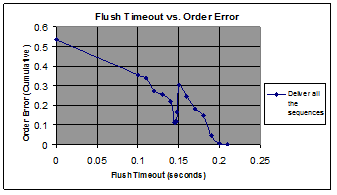
Freshness can be varied by varying the FLUSH_TIMEOUT. We did multiple trace runs, each time using a different value of FLUSH_TIMEOUT. At the end of each run, we recorded the cumulative order error. Figure 10 gives
shows the variation in order error as a function of flush timeout. X-axis
corresponds to the FLUSH_TIMEOUT chosen for a particular trace run. Y-axis
gives the cumulative order error obtained at the end of the run. As can be seen, as we increase the FLUSH_TIMEOUT,
the order error decreases. After a FLUSH_TIMEOUT of 0.2 seconds, the
ORDER_ERROR is zero. This shows that a time interval of 0.2 seconds is large
enough to fully order the packets without the need for sending any packet
unordered. The interesting thing to note is that there is sharp fall in order
error at a FLUSH_TIMEOUT of 0.147 seconds. After this point the order error
again jumps up and continues to decrease at a normal pace. It looks like that
this is related to the rate at which packets are being received by the packet
scheduler. If the packet receive rate becomes equal to the average rate at
which the queue/packet scheduler mechanism is delivering packets to the Local
server, then we reach a point where the order error is very low. i.e. at this
point on an average most of the packets that come in are being periodically
being delivered leaving the queue empty. Since now the chances of a stale
packet are being left in the queue and then later on interfering with the
LAST_PACKET_SENT becomes very low, the order error tends to be minimal. When we
go left or right of this point there is mismatch between, the two rates and
hence, order error maintain its gradual downward slope. When we decrease the
FLUSH_TIMEOUT, we effectively reduce the chances for a packet to find its
predecessor. This will be true since we are delivering the packet without
waiting for new packets to arrive (here the instantaneous incoming packet rate
tend to be higher that the outgoing delivery rate). Hence there are more
unordered packets resulting in the increase in order error. On the other side,
if we increase the FLUSH_TIMEOUT, the rate of incoming packets is more that the
rate of outgoing packets. This results in the packets getting accumulated in
the Queue. Hence our order error rises initially and then comes back to track
of decreasing with a gradual slope.
B.
Subjective User Experience and Order Error / Freshness Variation
We did multiple trace runs, where in each case we varied the FLUSH_TIMEOUT as before. In each trace run, we logged the subjective user experience. Goodness of game play cannot be measured quantitatively, but we can always get an expressive view of a game. We can let a user play the game and log the subjective user experience. This is what we did and is shown in Figure 11. It is clearly evident from the table that when the FLUSH_TIMEOUT was low (i.e. the order error was high), the user saw lots of false moves in the game. On the other hand when the FLUSH_TIIMMEOUT was relatively high (ORDER_ERROR was low, but freshness was high), the user experienced jitter in the game. Hence we should avoid these two extremes and try to have a compromise between the two. The point where we got a sharp decline in order error earlier seems like a good point to operate the game.
C. Queue Delivery
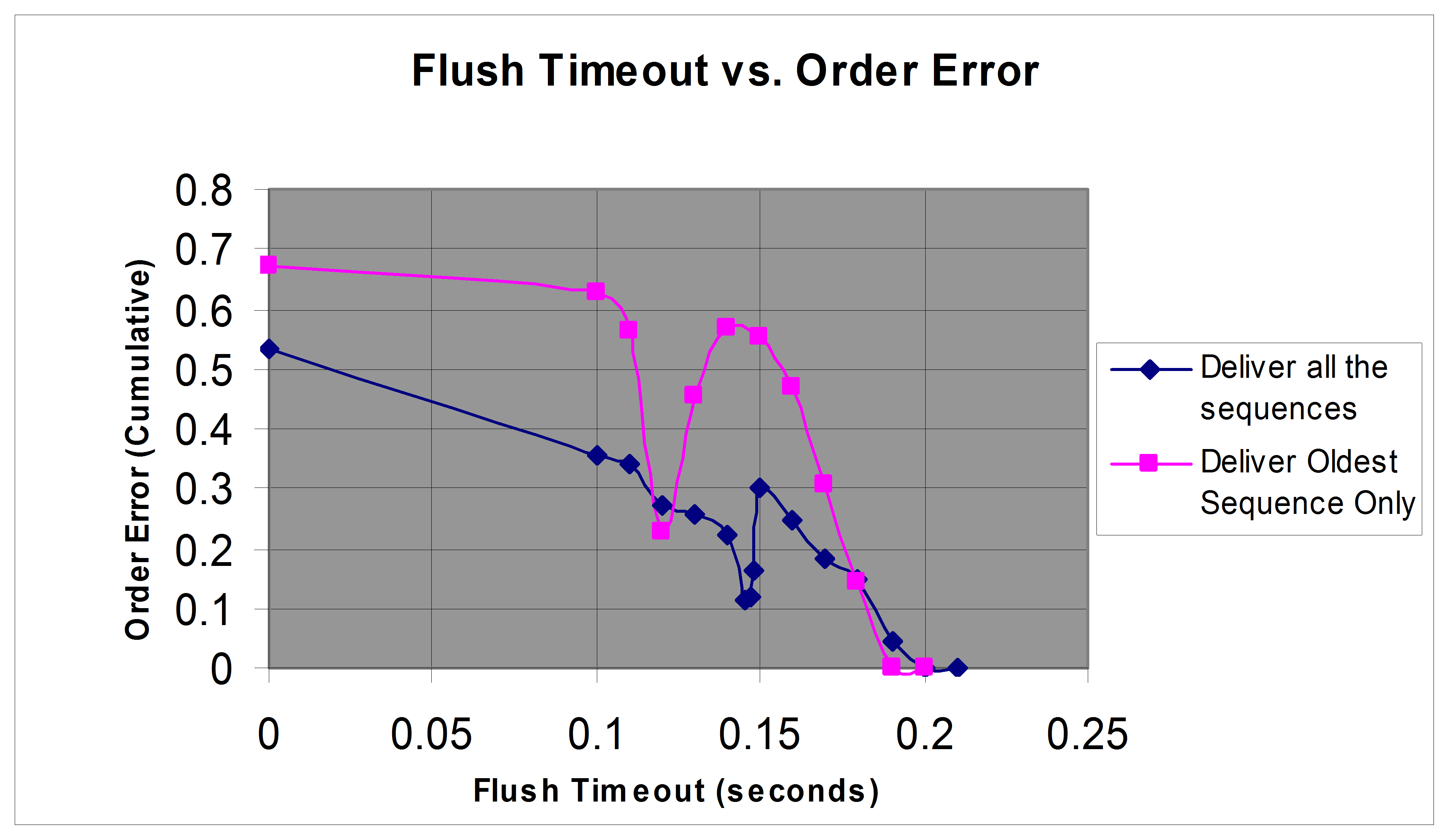
We experimented with two methods for how to deliver the Queue contents when there is a FLUSH_TIMEOUT. In the first set of experiments, we delivered all the sequences in the Queue. In the second set, when a FLUSH_TIMEOUT occur, we only deliver the sequence that contains the packet that was responsible for the FLUSH_TIMEOUT. The rest of the sequences in the queue remain stored. This is show in figure 12. Intuitively, one may think that the case when we delivered only one sequence unordered, the order error should be lower. But that was not what we saw in the experiments. We saw that the case in which we deliver all the sequences in the queue performed better that the case where we were delivering only one sequence. The graph characteristics were the same in both the cases and there was a sharp drop in order error at FLUSH_TIMEOUT = 0.12 seconds for the case when we delivered only the stale sequence.
It is interesting to see the reason behind the unprecedented results. When we were delivering just one of the sequences, it was quite possible that we were leaving some packets in the queue that were old but arrived late hence they were not yet stale. Now when they eventually got stale, they were forced out of the queue to be delivered to the local server. When this happened, the LAST_PACKET_SENT was set to a value corresponding to one of these old packets. This resulted in the new packets that came later to be added to the queue instead of being sent directly out to the local server. Hence the order error was increased.
Another interesting fact that can be seen from figure 12 is that the local minima in the case where we delivered just one sequence was attained earlier (at FLUSH_TIMEOUT = 0.12 sec) that the case when we delivered all the packets in the queue (FLUSH_TIMEOUT = 0.147 secs). This is related to the fact that when we deliver only one queue, on an average we are delivery less number of packets. Hence the instantaneous rate of packet deliver is less that when we deliver all the sequences in the queue. Hence to match with the incoming packet rate, we need to increase the frequency of packet delivery. I.e. we choose a lower value of FLUSH_TIMEOUT.
D.
Varying The Number of Active Peers
 |
| Variation of order error by varying the number of active peers |
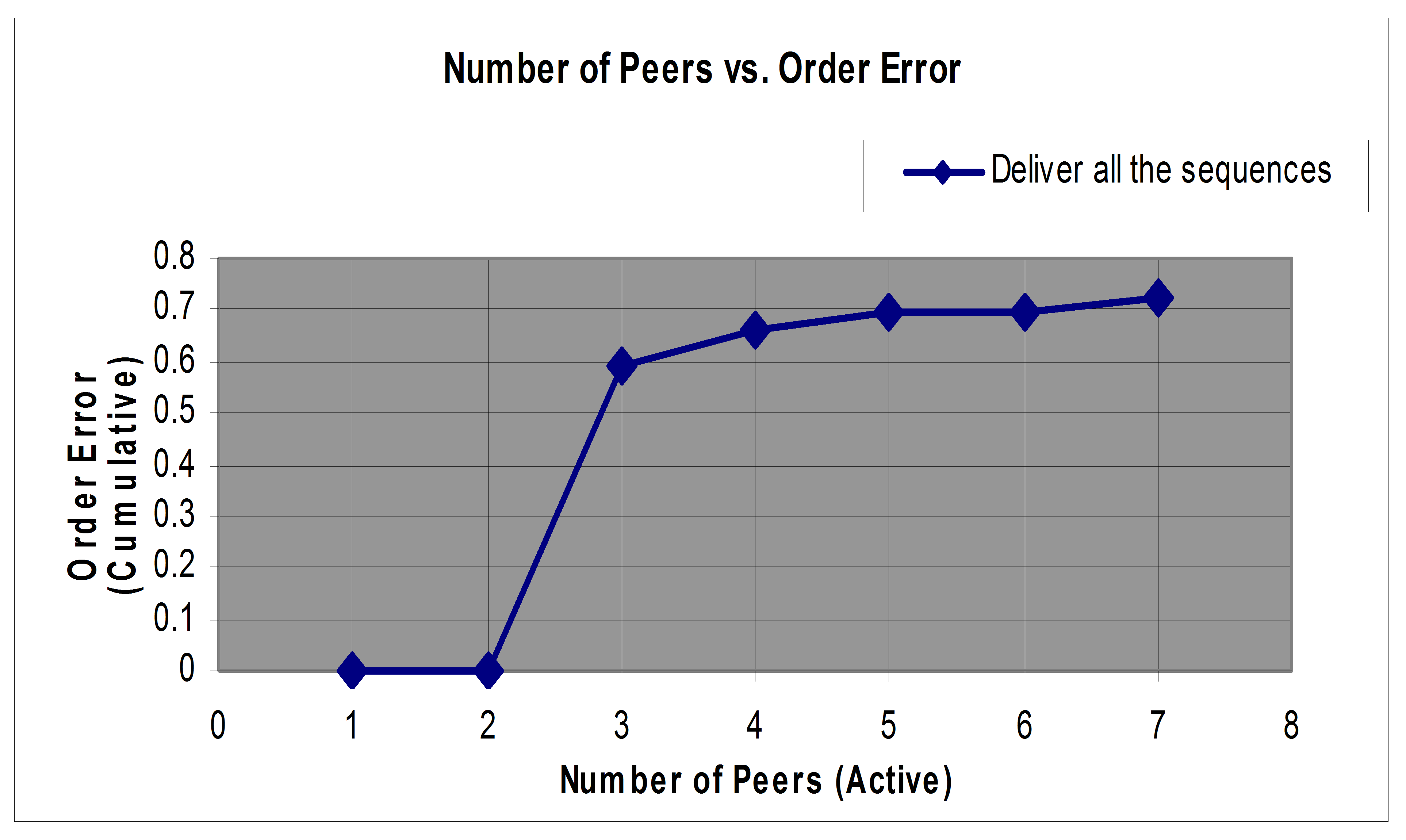
To see if our system was scalable or not, we varied the number of active peer from 1 through 7. In each trace run, we took different number of peers while keeping the FLUSH_TIMOUT to a constant value of 0.15 secs. As shown in figure 13, the order error was zero for the case when the number of active peers was 1 and 2. From 3 onwards, the order error was relatively constant. It showed a variation of only about 0.1.
It is easy to image the theoretical reasoning behind the graph characteristics. FLUSH_TIMEOUT of 0.15 seconds was enough for the all packets to get ordered when the number of peers (active) was 1 and 2. For 3 onwards, the unordered packets increased since the time interval of 0.15 seconds was not sufficient for perfect ordering. But the number of unordered packets remained about the same. If we decrease the FLUSH_TIMEOUT to a lower value, it is quite possible that even at 2 active peers, the order error is non-zero. Hence the system order error is not dependent on the number of peers, but a system parameter (FLUSH_TIMEOUT). Hence our system should be able to scale.
E. State Divergence
This plays an important role in the over all design of the
system. We can classify divergence into two main categories:
- Trivial Divergence: In this case the peers may have game state that varies to some extent, but still the game state passes the consistency checks by local server. Hence the game can itself correct and converge to the correct state.
- Non-Trivial Divergence: Here the game state between peers varies to the extent that the logical servers in peers reject subsequent game frames. In this case the server will disconnect the local/remote client.
Quake is robust enough to take care of trivial divergence. If few of the packets are lost, Quake game engine is able to correct itself. This happens transparently. This makes it difficult for us to detect trivial divergence. Non-trivial divergence can be easily detected by checking if the server disconnects or not. If any of the servers (in the peers) disconnects anyone of the clients that are registered with them, we can conclude that we are encountering a non-trivial divergence. Hence to evaluate the performance of our multicast architecture, one can:
- Check if the Local Servers at each Peer starts discarding frames since they are coming un-ordered and hence disconnects the Local/remote Client. Related directly to the timeout parameter.
- Check the consistency of the Environment – check if the scores at each Peer matches, position of each user entity is same on each machine.
- Check when the user tries to moves in the environment and interacts with the objects, he does not encounter unexpected results. E.g. he tried to go forward and the Quake Game Engine moves him backwards crashing him into the lava pit. This to some extent gives us an indication of non-trivial divergence.
For the first check, we saw that with a timeout of about
100msec, the Local Server never disconnected any of the clients (local as well
as remote). This timeout value was derived directly from the End-to-End Message
Delay that was obtained from the trace runs. We were not able to perform the second
check since we were having some problems with the OpenGL graphic rendering
engine of Quake which some how managed to just show the local user and not the
other player in the game irrespective of the fact that the Local Server was
executing commands for other remote peers too (confirmed by trace dump from the
Local Server). The Last check was also successful and the user was easily able
to move around in the Quake Environment without facing significant jitter in
the movement.
 XMOHAN