 XMOHAN
What does the system notice?
Investigating multimodal observation, context, environmental change and how observations become usable experience.
My present scientific work at Robometrics® AGI investigates how machines can learn through experience, integrate perception, memory and action, and adapt to changing physical environments. The research program explores original AI model architectures, continuous on-device learning, and recursive self-improvement.
Research status. These are active research directions and open scientific questions, not assertions that artificial general intelligence, autonomous recursive improvement, validated safety-critical operation, subjective feeling, or machine consciousness have been achieved.
Most language models learn primarily from curated data or mediated interaction. Our research asks what changes when intelligence must operate in a physical world: observing uncertain conditions, retaining useful experience, choosing actions and receiving feedback from those actions. The scientific agenda joins perception, memory and action in architectures that may adapt to new environments.
Investigating multimodal observation, context, environmental change and how observations become usable experience.
Studying experience-dependent memory and how prior interactions inform later judgment without treating retrieval alone as learning.
Investigating feedback between action and the changing physical environment, including situations that are unfamiliar or incomplete.
One research direction is intelligence that can adapt through use on local hardware instead of requiring every new experience to be mediated by a remote training system. Original AI model architectures, continuous on-device learning and recursive self-improvement are current lines of investigation. Methods, operational boundaries and performance claims must be demonstrated rather than inferred from prototypes or project plans.
Relevant questions include learning efficiency on memory- and power-constrained devices; retaining useful experience without losing earlier capabilities; how a system can evaluate proposed self-changes; and what evidence would show an improvement is real and reproducible.
Current applied research includes perceiving and interpreting human emotional cues. The broader inquiry asks whether emotion- or instinct-inspired mechanisms can contribute to attention, motivation, context-sensitive decision-making and a form of practical common sense. A proposed digital limbic architecture is a research concept within that investigation, not a claim that any machine currently possesses a biological analogue or a conscious inner life.
Artificial feeling, subjective experience, consciousness and the relationship between behavior and internal states remain open philosophical and scientific questions. Recognizing an emotional expression, imitating empathy or following a convincing conversation does not establish consciousness.
Robometrics® Machines is a distinct product-development organization associated with the research-led Robometrics® AGI umbrella. Its aviation programs provide a concrete context for studying how AI can communicate useful information to people operating under time, attention and hardware constraints. These applied products are not equivalent to an achieved general intelligence architecture.
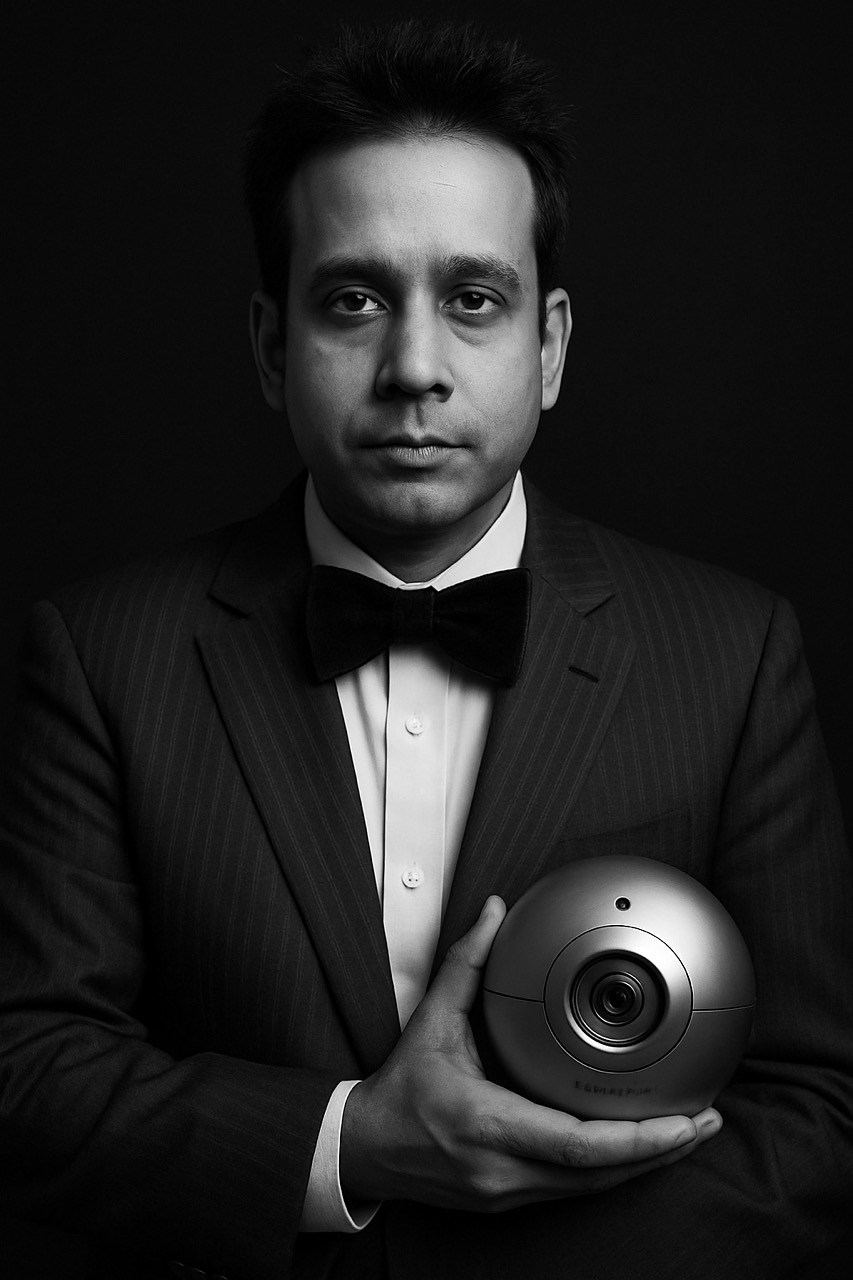
The photographed enclosure provides a tangible illustration of the effort to connect machine perception, local computing and human interaction. The same enclosure form is also used for Amelia™ in the aviation program, where interface design and pilot context are central research and engineering concerns.
This is a pre-production research prototype. Its appearance does not imply achieved general intelligence, machine consciousness, operational certification or independently validated aviation safety performance.
Investigating conversational retrieval from aircraft operating documents, model limitations, traceability to manuals, and local operation on constrained hardware. This is advisory research and product development, not a replacement for approved aircraft guidance or pilot judgment.
Exploring pilot condition, aircraft state, situational awareness, stress and critical-event signals, and spatial or holographic interfaces. These are program objectives and research topics; no claim of certified or independently validated accident prevention is made here.
Aviation, photography and ballroom dance inform questions of perception, workload, movement and trust in automation. These perspectives shape inquiry rather than substitute for scientific evaluation.
The historical research archive documents earlier scientific papers, laboratory experiments and manuscripts at Brown, HP Labs, MIT Media Lab, IBM Research Zurich and Intel Research Berkeley. Subsequent work spans enterprise systems, AI technology, software architecture, licensing, applied product development, technology evaluation and the governance of intelligent systems.
At Oracle, I worked across cloud management, virtualization, application and systems management, licensing and enterprise integration, including technology diligence relating to multiple acquisitions. Later work at CloudVolumes examined cloud workloads and application virtualization.
Technical advisory, diligence and applied engineering work has examined model capability and limitations, AI and robotics, enterprise software, cybersecurity, open-source dependencies, cloud and edge infrastructure, and technology economics. This professional practice informs the questions I investigate but is not presented as a scientific publication.
Public writing considered intelligent homes, transparency, classification and regulation of AI systems, and the connection between AI development and immigration policy. The relevant items appear in the publications and writing record.
At EAA AirVenture Oshkosh, selected talks and demonstrations have included aircraft artificial intelligence (2022), generative AI for aviation and Amelia™ (2025), and generative AI for aviation and artificial general intelligence (2026). These are public presentations and applied programs, not claims of independently verified general intelligence or aviation certification.
Research at Skive it, Inc. explored contextual visual interpretation—style, mood and sentiment signals extracted from video—and natural-language search for experiences. The company's proposed AI system-on-chip extended this inquiry toward human-aware robot interaction. These historical ideas help explain the scientific continuity of the present emotion-perception and embodied-intelligence program, without implying that machines capable of subjective feeling were achieved.
Research should be open to criticism, replication and clear distinctions between hypothesis, prototype, publication and evidence. The publications and manuscripts catalog identifies historical peer-reviewed conference contributions, technical reports, posters, original research manuscripts, patent applications and later AI-policy work separately.
The independent lab's research agenda should not be confused with deployed or certified applied AI products. The Robometrics® Law Foundation remains a separate public-interest organization concerned with access to justice and AI law, policy and governance.